
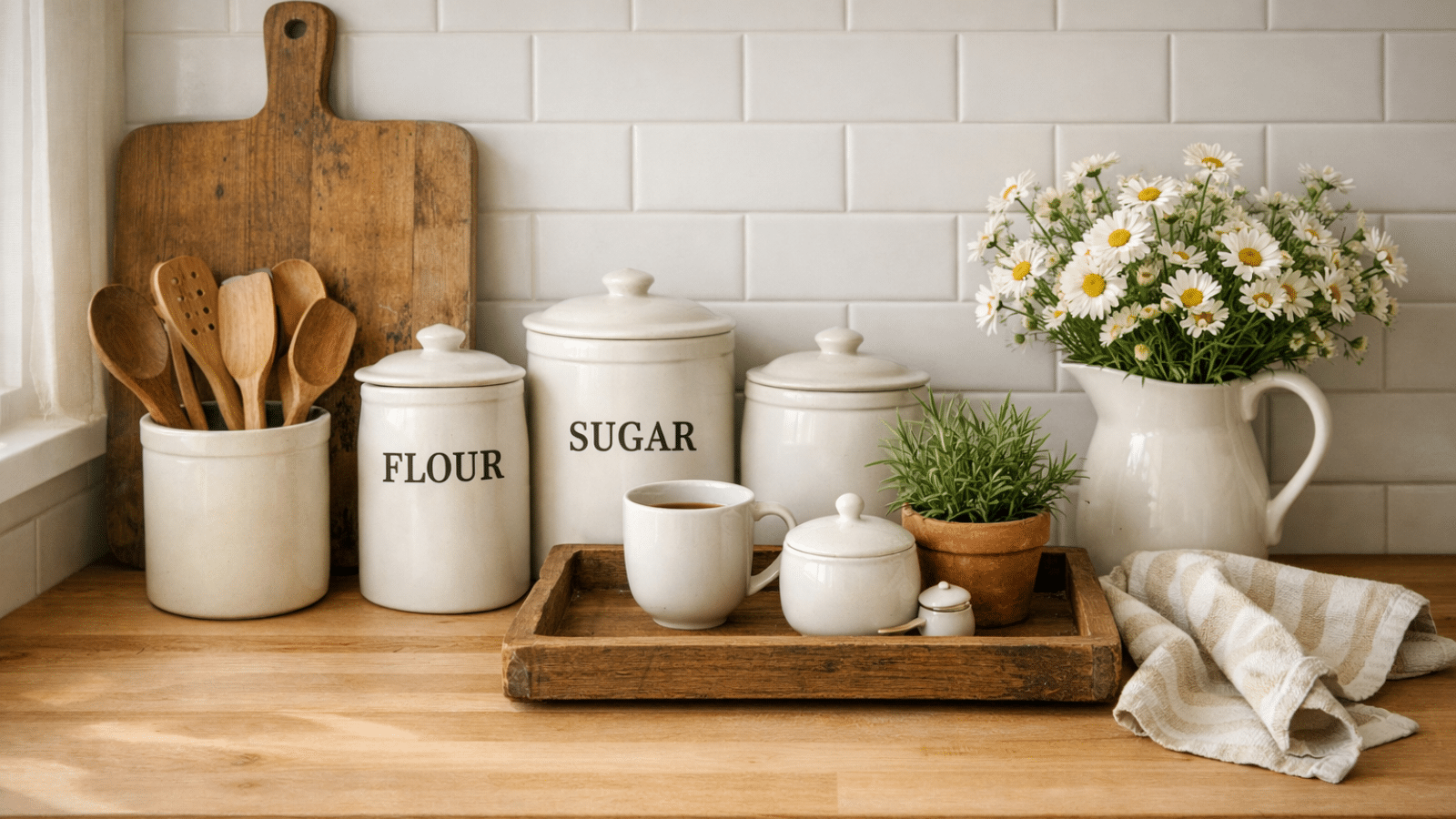
Farmhouse kitchen decor has a reputation problem. Mention it, and people either picture a Pinterest-perfect cottage with chickens roaming the yard, or they think of that one friend whose kitchen looks like they bought out the entire “Live, Laugh, Love” section at HomeGoods. But real farmhouse counter decor is neither of those things.
Real farmhouse style is about warmth, function, and making your kitchen feel like the heart of your home, not a museum of rustic tchotchkes. It’s ceramic crocks that actually hold your wooden spoons, bread boxes that keep sourdough fresh, and vintage-inspired pieces that look lived-in, not staged.
If you’re drawn to natural materials, cozy textures, and a kitchen that feels welcoming rather than sterile, you might be a farmhouse person. Not sure? Take our kitchen counter decor style quiz to find out!
This guide will walk you through exactly what makes counter decor feel farmhouse (versus just rustic or country), plus the specific pieces that pull the whole look together.
(Want to explore other kitchen counter styles first? Our complete kitchen counter decor guide covers modern,
organic, japandi, and more.)
What Makes Counter Decor “Farmhouse”?
Before we dive into shopping lists and styling tips, let’s talk about what actually makes kitchen counter decor feel farmhouse. (Hint: it’s not just about painting everything white and adding a wooden sign.)
Materials Matter
Farmhouse style gravitates toward natural, honest materials. Think butcher block countertops, reclaimed wood trays, ceramic crocks, and stoneware pitchers. You’ll see weathered wood finishes, hand-thrown pottery, and vintage-inspired metals like galvanized steel or aged copper. The key is that everything looks like it could have been collected over time, not bought as a matching set at a big box store.
Natural stone countertops like marble or soapstone fit beautifully, but so does butcher block that shows its wear. In fact, farmhouse style is one of the few aesthetics where a little patina and character actually improves the look.
The Color Story
Farmhouse counters start with a neutral foundation: whites, creams, soft grays, and natural wood tones. This isn’t about being bland, it’s about creating a calm backdrop that lets your collections shine. Warmth comes from those wood tones and weathered finishes, not from paint colors.
When you do add color, it’s soft and natural: sage green herbs in terracotta pots, dusty blue vintage crocks, or the gentle pink of fresh flowers. You’re not going to see bright primary colors or matchy-matchy coordinating sets. If it looks like it came from a farmhouse garden or a vintage shop, you’re on the right track.
Functional Beauty
Here’s what separates real farmhouse style from the themed version: everything has a job. Your ceramic canisters actually store flour and sugar. Your utensil crock holds the wooden spoons you use every day. Your bread box keeps sourdough fresh. Your dish towels dry dishes.
Farmhouse counter decor celebrates the tools and containers you use daily, but it also makes them beautiful enough that you want to leave them out. Nothing’s there purely for show. If you haven’t used it in a week, it doesn’t belong on your counter.
The Collected-Over-Time Vibe
The best farmhouse kitchens look like they came together gradually: a crock from your grandmother, a cutting board from the farmer’s market, a vintage breadbox from an antique shop, and a new set of linen towels that tie it all together. Even if you buy everything new, you want it to feel curated, not coordinated.
This means mixing different wood tones, combining old and new pieces, and being okay with a little imperfection. That chip on your ceramic pitcher? That’s character. The worn spot on your wooden board? That’s proof you actually use it.
Essential Elements for Farmhouse Counter Decor
Now that you know what makes counter decor feel farmhouse, let’s look at the specific pieces that pull it together. You don’t need everything at once. In fact, starting small and building gradually is more farmhouse than buying it all in one shopping trip.
Storage Canisters & Crocks: The Foundation
The backbone of any farmhouse counter is ceramic canisters and storage jars. These are the pieces you’ll use every single day, and they set the tone for everything else.
Look for stoneware crocks with a slightly handmade feel—the kind that look like they could have come from a pottery barn (the actual building, not the store). Vintage-inspired labels (“FLOUR,” “SUGAR,” “COFFEE”) add charm, but simple white ceramic works just as well. The key is that they’re substantial and feel good in your hand, not flimsy or overly modern.
When choosing canisters, think about what you actually store on your counter. Flour, sugar, and coffee are the classics, but you might also want containers for oats, tea, or baking supplies. Group them in odd numbers—three large canisters look intentional, two look incomplete, five creates visual interest across a longer counter.
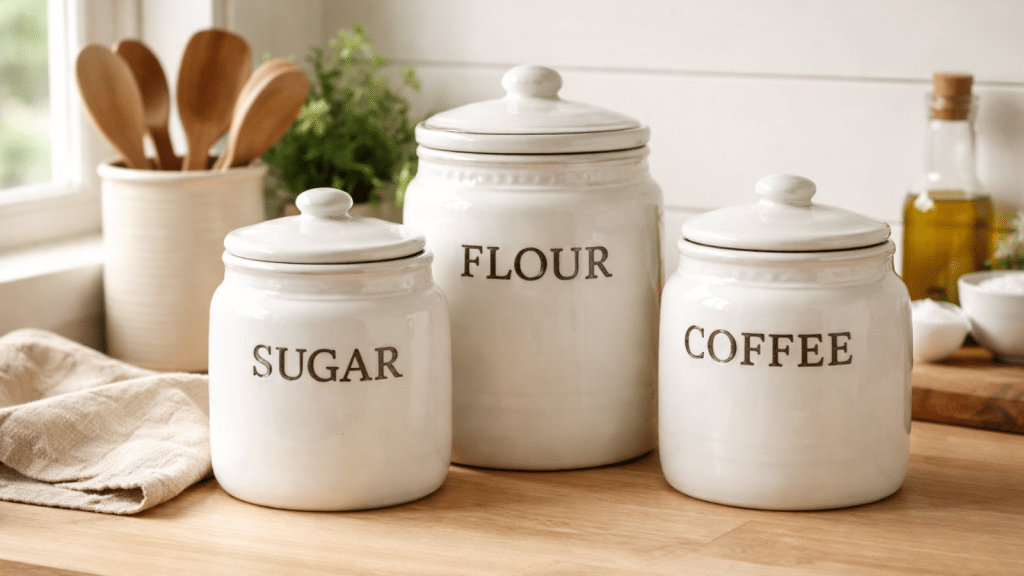
Don’t buy a matching set of ten. Buy three to five pieces you genuinely need, and let them anchor your counter. You can always add more later if you find you need them.
How to style canisters:
- Group flour, sugar, and coffee canisters together near your baking or coffee area
- Add a ceramic utensil crock to the grouping for balance
- Place them directly on the counter or on a wooden tray
- Keep labels or decorative sides facing forward
- Leave a little space between each one—they shouldn’t be crammed together
If you want to see how canisters work across different kitchen styles (modern, organic, japandi), there are great guides out there comparing options. But for true farmhouse, stick with ceramic or stoneware, and avoid glass or plastic.
Wooden Trays & Cutting Boards
A wooden tray is your secret weapon against counter chaos. Instead of random items scattered across your counter—coffee maker here, sugar bowl there, random mug over there—a tray pulls everything into one cohesive vignette.
Use a rustic wooden tray (think walnut, oak, or reclaimed wood with visible grain) to organize your coffee station, your baking supplies, or your daily essentials. Suddenly, instead of clutter, you have a composed little scene. Bonus: when you need to wipe down your counter, you can just lift the whole tray!
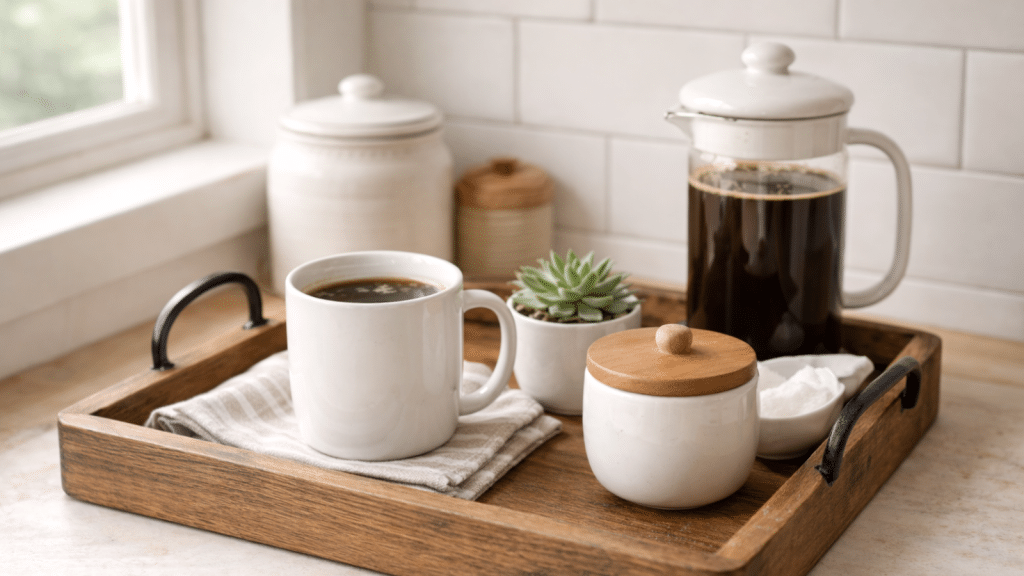
Cutting boards double as farmhouse decor when you’re not using them to chop vegetables. A large wooden board propped against your backsplash adds warmth and height, especially behind lower items like canisters. Smaller boards can lean on open shelving or hang from brass hooks on the wall.
Choose solid wood in warm tones—maple, walnut, cherry, oak—over bamboo, which reads more modern than farmhouse. Mix sizes and wood tones for that collected feel. One large statement board, a couple medium ones for actual use, and maybe a small cheese board for serving.
Styling ideas with trays and boards:
- Coffee station on a large wooden tray: coffee maker, two mugs, sugar bowl, small plant
- Baking station: flour and sugar canisters on a tray with a wooden spoon crock
- Large cutting board propped behind counter items for height and texture
- Stack two or three cutting boards of different sizes leaning against the backsplash
- Use a tray to “zone” your counter—everything within the tray is the coffee area, everything outside is for cooking
Trays and boards are also great for adding variety in wood tones. If your counters are butcher block, a darker walnut tray adds contrast. If you have white marble, warm oak brings in coziness.
Utensil Holders & Kitchen Tools on Display
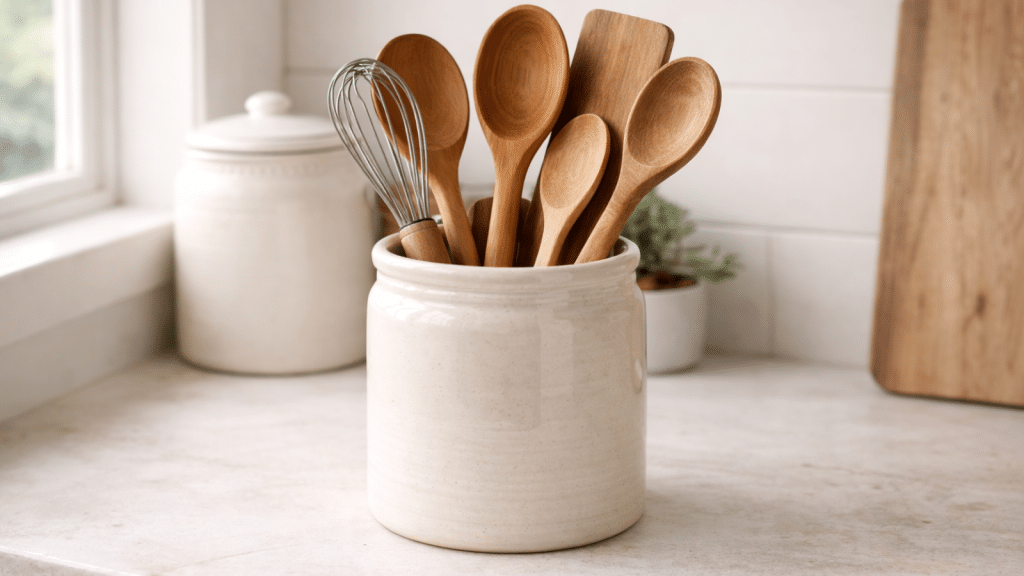
Your wooden spoons and vintage spatulas deserve better than being shoved in a drawer. A ceramic utensil crock keeps them accessible by the stove while adding to your farmhouse aesthetic.
Look for a wide-mouthed stoneware crock—something substantial enough that it won’t tip over when loaded with spoons. It should feel heavy and handmade, not delicate or decorative. Neutral colors work best: cream, white, soft gray, or natural clay tones.
What to display:
- Wooden spoons and spatulas (keep the plastic ones in the drawer)
- Vintage whisks with wooden or wire handles
- A well-worn wooden rolling pin propped nearby
- Stainless steel or copper measuring cups hanging from hooks
The key is that these are tools you actually use. This isn’t about staging a photo shoot—it’s about making your daily cooking tools beautiful enough to leave out. If you reach for a utensil multiple times a day, it earns its spot in the crock.
Keep your utensil holder near where you actually cook—next to the stove or your main prep area. Form follows function in farmhouse kitchens.
Bread Boxes & Practical Storage
A vintage-style bread box is one of those pieces that serves double duty: it keeps your sourdough and baked goods fresh, and it adds instant farmhouse charm. Plus, it hides the less-pretty stuff—crackers, snack bags, English muffins—that you want accessible but not on full display.
Look for enamel bread boxes with aged or distressed lettering, wooden boxes with a worn finish, or classic galvanized metal. Avoid anything too shiny or new-looking. You want it to feel like it’s been in your family for decades, even if you bought it last week.
Bread boxes work especially well if you have limited counter space but lots of small items that need homes. Toss in your daily bread, a box of crackers, and some granola bars, close the lid, and suddenly your counter looks cleaner without actually putting things away.
Textiles: Towels, Runners & Soft Touches
Don’t underestimate the power of fabric to soften a kitchen. Farmhouse counters always have some textile element—usually dish towels, but sometimes a small linen runner or a cotton placemat under a coffee station.
Classic farmhouse towels are striped (think French ticking stripes or grain sack stripes), checked, or simple linen weaves. Avoid anything with cutesy sayings or overly decorative patterns. The fabric should be linen or cotton, never synthetic, and the more they’re washed and worn, the better they look.
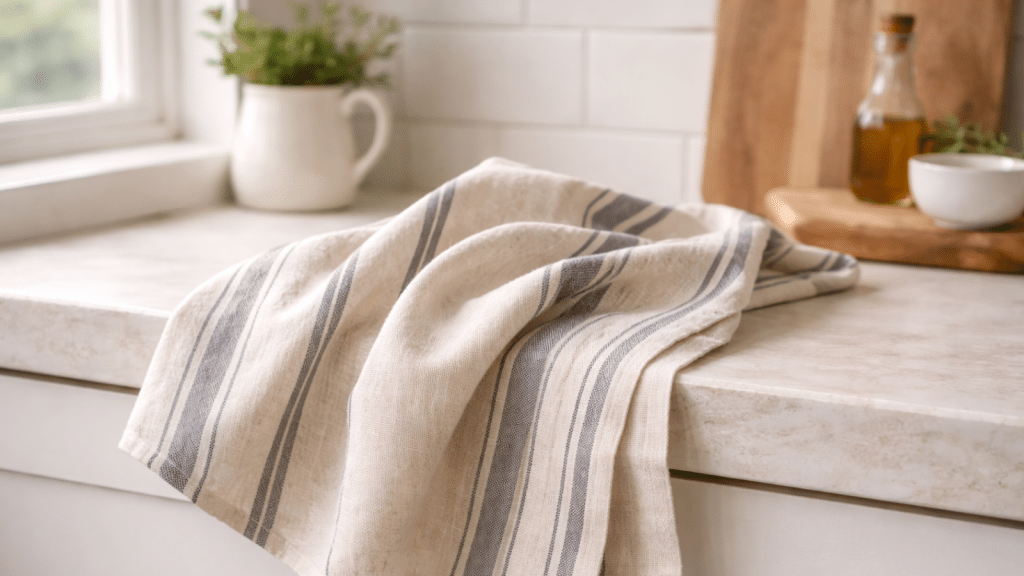
How to display kitchen towels:
- Drape one casually over your oven handle
- Fold one on your coffee tray or baking station
- Tuck one in a wire basket near the sink
- Hang a couple from hooks or a small towel bar
Rotate your towels seasonally. Lighter weight and color in summer (think bright white or soft blue stripes), cozier textures and warmer tones in fall and winter (cream, oatmeal, rust-colored stripes). This is an easy, inexpensive way to refresh your counter’s look without buying new canisters or boards.
A small linen runner under your coffee station adds another layer of texture and helps define that zone as its own little area. Keep it simple and neutral—no patterns or embellishments needed.
Greenery & Fresh Touches
Farmhouse counters always have something living on them. Not a big, fancy floral arrangement—something simple and unfussy that looks like you grabbed it from the garden on your way inside.
Fresh herbs are peak farmhouse. A pot of basil by the stove, rosemary near your cutting board, or thyme in a small ceramic planter. They’re functional (you actually use them in cooking), they smell amazing, and they bring life to the space. Terracotta or simple white ceramic pots work best—nothing too decorative.
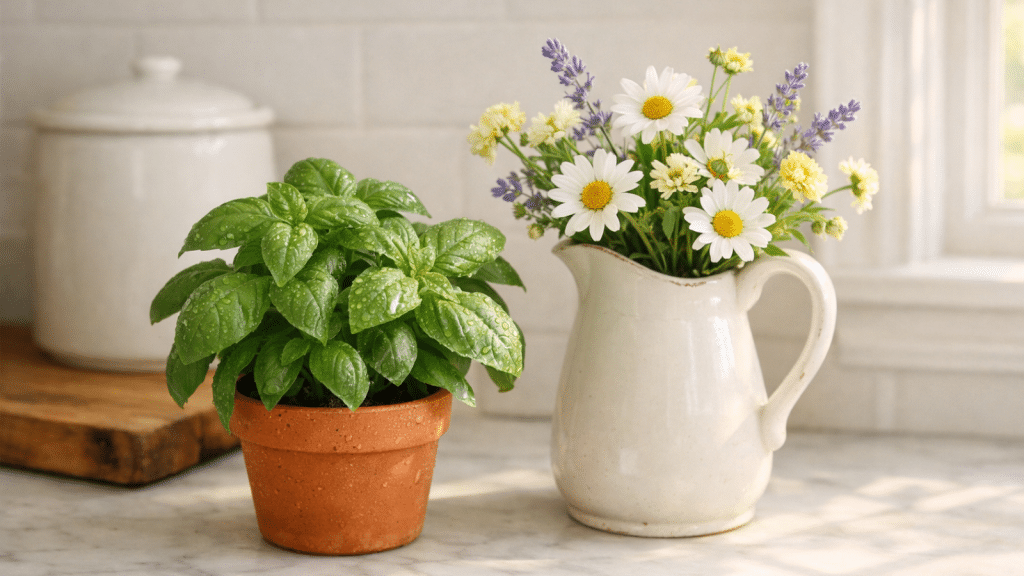
If you’re not great with keeping herbs alive, a small succulent in a ceramic planter is equally farmhouse and much more forgiving. Or go with faux greenery: a stem or two of eucalyptus in a vintage pitcher looks real and lasts forever.
Flowers should be simple—daisies, wildflowers, whatever’s at the grocery store or farmer’s market. Put them in a vintage pitcher or mason jar, not a formal vase. The whole point is that it looks natural and unforced.
Best plants for farmhouse counters:
- Basil, rosemary, thyme, or other cooking herbs in terra cotta pots
- Small succulents in ceramic planters
- Eucalyptus stems (real or good-quality faux) in a pitcher
- Simple grocery store flowers: daisies, sunflowers, tulips, or whatever’s seasonal
Keep it to one or two plants on your counter—you’re not trying to recreate a greenhouse. Just a touch of green life to soften all that ceramic and wood.
Choosing the Right Appliances
Your coffee maker and toaster don’t have to be vintage to work with farmhouse style—they just can’t look like they belong in a spaceship. Modern farmhouse is all about blending contemporary function with rustic warmth, and your appliances are part of that.
For coffee makers, look for simple designs in white, cream, or brushed stainless steel. Avoid ultra-modern shapes, matte black finishes, or bright colors. If you love your Nespresso or Keurig but it’s not the right vibe, tuck it on a tray with farmhouse accessories that help it blend in.
Stand mixers in cream, white, or classic stainless fit beautifully. If you have a colorful one you love, that’s fine—just make sure your accessories (canisters, utensil crocks) are neutral to balance it out.
The most important thing? If you use it daily, it can stay on the counter regardless of color. If it’s the right tool for your cooking but the wrong aesthetic, focus on surrounding it with pieces that feel more farmhouse—wooden trays, ceramic crocks, linen towels—and it’ll blend in better than you think.
How to Style Farmhouse Counters (Without Looking Like You Tried Too Hard)
Having the right pieces is half the battle. The other half? Knowing how to arrange them so your counter looks intentional instead of cluttered. Here’s what actually works.
The Rule of Odd Numbers
This is design 101, but it’s especially important in farmhouse styling: group items in odd numbers. Three canisters look deliberate. Two look like you’re still shopping. Five items on a tray create visual interest. Four feel awkwardly balanced.
This doesn’t mean you need to count every single item obsessively. But when you’re setting up a vignette—say, your coffee station—think in threes or fives. Coffee maker + two mugs + small plant. Or coffee maker + sugar bowl + utensil crock + folded towel + tiny succulent.
The odd number creates a natural focal point (usually the tallest or largest item) with supporting pieces around it. Even numbers feel too symmetrical and formal, which isn’t the farmhouse vibe.
Create Functional Vignettes
Here’s the farmhouse secret: group things by how you actually use them, not just by how they look together. This is what makes farmhouse styling feel natural instead of staged.
Coffee station vignette: Wooden tray + coffee maker + sugar bowl or canister + small plant + folded dish towel. Everything you need to make coffee is right there, looking like a composed little scene.
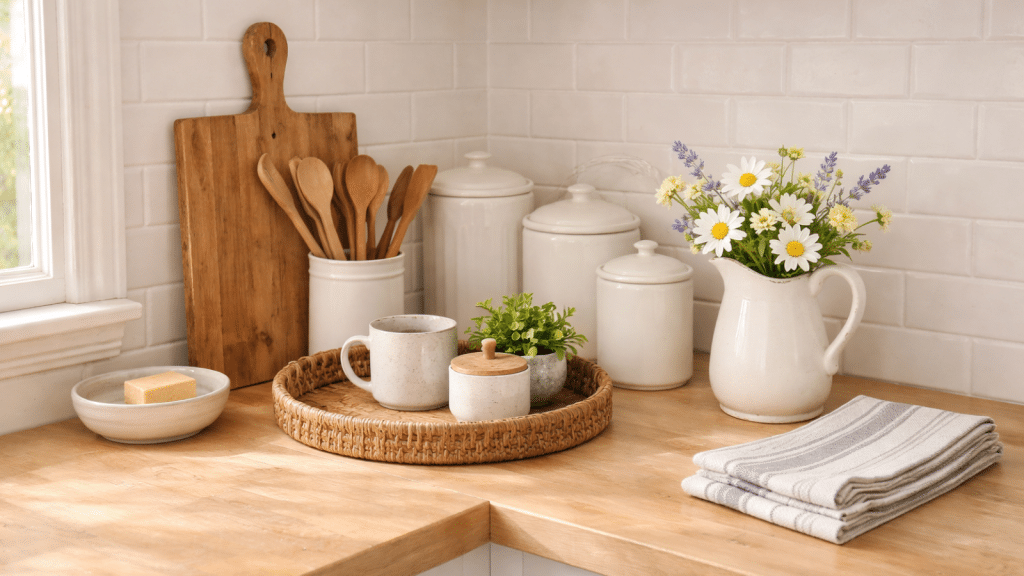
Baking zone: Flour and sugar canisters + utensil crock with wooden spoons + cutting board propped behind them. When you’re ready to bake, you reach for the canister, grab a spoon from the crock, and pull down the board.
Sink area: Soap dispenser (choose ceramic or glass, not plastic) + small plant in a ceramic pot + folded dish towel. Clean and simple, but still styled.
The key is that every grouping should make sense functionally. Don’t put flour canisters by the coffee maker just because they look cute together—they belong near where you bake. Don’t style your herbs by the sink if you cook at the stove. Form follows function.
Mix Heights, Textures & Finishes
Visual interest comes from variety. If everything on your counter is the same height, it looks flat. If everything is smooth ceramic, it lacks dimension.
Aim for three levels in each grouping:
- Tall: Utensil crock, large canister, plant in tall pot, cutting board propped vertically
- Medium: Standard canisters, bread box, coffee maker, small bowl
- Low: Tray, folded towel, small plant in short pot, soap dispenser
Mix textures too:
- Hard surfaces: ceramic, wood, stone
- Soft touches: linen towels, plants, flowers
- Different finishes: matte ceramic, glossy glaze, raw wood, brushed metal
This is where farmhouse style shines—it’s not meant to be perfectly matched. Your walnut tray doesn’t have to match your oak cutting board. Your cream canisters don’t have to match your white bread box. In fact, they probably shouldn’t. The variety is what makes it interesting.
Know When to Stop
Farmhouse isn’t minimalist, but it’s not maximalist either. You’re allowed to have things on your counter—encouraged, even—but if you can’t prep dinner without moving fifteen items, you’ve gone too far.
Here’s a good test: Can you comfortably chop vegetables, roll out dough, or set down a hot pan without rearranging your decor? If no, scale back.
Guidelines for what stays out:
- Daily use: Coffee maker, utensil crock, dish soap, cutting board you use constantly
- Multiple times a week: Flour/sugar canisters, bread box, oil and vinegar, fruit bowl
- Occasional use: Stand mixer (if you have space), specialty appliances, large serving bowls
If you haven’t touched it in a week, it goes in the cabinet. Farmhouse is about functional beauty, not decorating for decoration’s sake.
Also, clear one full zone for actual food prep. Even if your counter is 12 feet long, you need at least 2-3 feet of completely clear space for working. That’s non-negotiable.
A Note on Countertop Materials
Your countertop itself sets some of the tone. This guide focuses on what goes on your counters, not the counters themselves, but it’s worth noting:
Butcher block is peak farmhouse—warm, forgiving, develops character over time, and pairs beautifully with ceramic and linen. It does need maintenance (oiling, occasional sanding), but many people find that ritual part of the charm.
White marble or quartz keeps things bright and classic. It’s the “modern farmhouse” choice—a little more polished, very popular right now, easier to maintain than wood.
Soapstone is quieter and less common, but it ages beautifully and gets better with patina. If you like the idea of your counter showing its history, soapstone is wonderful.
Farmhouse style works with any of these. Just know that natural materials (wood, stone) feel more farmhouse than engineered quartz or laminate, though you can absolutely make those work with the right accessories.
Seasonal Farmhouse Counter Touches
One of the best things about farmhouse style? It’s incredibly easy to refresh seasonally without buying all new decor. Swap out a few small items and your counter feels completely different.
Spring
Fresh tulips or daffodils in a ceramic pitcher. Lighter linens in cream, white, or the softest pastels. Herbs starting to grow in small terracotta pots. Maybe a wooden bowl with pastel eggs if you celebrate Easter, but keep it subtle—no cartoonish decorations.
The vibe is: fresh, new growth, waking up after winter. Your counters should feel a little lighter and brighter. Swap heavy textures for airy linens, dark wood for lighter pieces.

Summer
Lemons or limes in a wooden bowl. Bright white counters with light wood accents. Fresh herbs at their absolute peak—basil in full bloom, mint taking over. Lightweight cotton towels in crisp white or soft blue stripes.
Summer farmhouse is about simplicity and the abundance of the garden. Your counter should feel open, uncluttered, and ready for making lemonade or tomato sandwiches.
Fall
This is when farmhouse style really shines. Small pumpkins and gourds (real or high-quality faux) in a wooden bowl or scattered on a tray. Wheat stalks or dried flowers in a pitcher. Warmer-toned towels in rust, mustard, oatmeal, or brown. Apples in a wooden bowl.
Fall is cozy without being cluttered. You want your counter to feel like a harvest bounty, but edited—not every gourd and leaf from the craft store.
Winter
Evergreen sprigs in a vintage pitcher. Pinecones in a wooden bowl. Cozier textures: chunky knit towels, heavier linens, maybe a small wool runner. Keep colors neutral—creams, whites, natural greens and browns. No red and green Christmas explosion unless that’s genuinely your vibe.
Winter farmhouse is about bringing a little nature inside when the world outside is bare. It should feel cozy and warm, like you’re preparing for a snowstorm.
The key to seasonal styling: Rotate just a few elements. Your core pieces—canisters, trays, utensil crocks—stay the same year-round. You’re just swapping the plants, adding seasonal produce, and changing your dish towels. It takes ten minutes and makes your kitchen feel fresh.
For more detailed seasonal ideas across all kitchen styles, you can find complete guides that dive deep into spring, summer, fall, and winter counter styling.
If You Love Farmhouse, You Might Also Like…
Modern Organic
If farmhouse feels a little too rustic or cottage-like, modern organic might be your sweet spot. It’s the sophisticated cousin—same love of natural materials and warmth, but with cleaner lines and a more minimalist approach.
Modern organic shares farmhouse’s appreciation for wood, ceramic, and plants, but dials down the vintage elements and rustic finishes. Think fewer crocks and cutting boards, more streamlined ceramics and simple planters. Still cozy, but more curated and a bit more zen.
If you like the idea of farmhouse but want it to feel less country cottage and more urban sanctuary, explore modern organic counter styling.
Modern
If you like the idea of styled counters but farmhouse feels too cozy or rustic, check out modern kitchen counter decor. It’s the opposite aesthetic—sleek, minimalist, and architectural—but still warm and livable. Perfect if you want clean lines instead of collected charm.
Industrial (For a More Urban Take)
For a more urban, edgy take on rustic, industrial kitchen counter decor pairs reclaimed wood with metal accents and exposed elements. It’s perfect if you like farmhouse but want it to feel less cottage and more loft apartment.
Industrial shares the love of natural materials and functional display, but swaps ceramic crocks for metal containers and vintage pitchers for concrete planters. It’s farmhouse’s cooler, more urban sibling.
Still Exploring Your Perfect
Kitchen Counter Style?
Take our 2-minute quiz to find out if you’re truly
Farmhouse, Modern, Organic, or Japandi
Plus get personalized product recommendations
Farmhouse Counter Decor: Frequently Asked Questions
What are the must-have items for farmhouse counter decor?
Start with these five essentials, and build from there:
- Ceramic canisters for storing flour, sugar, coffee, or pantry staples
- A wooden tray to organize your coffee station or baking supplies
- Utensil crock filled with wooden spoons and spatulas you actually use
- Fresh herbs or greenery in a simple pot or pitcher
- Linen or striped dish towels for texture and warmth
These five pieces give you the foundation. Everything else—bread boxes, cutting boards, more plants—builds on this base. Don’t try to buy everything at once. Farmhouse style works best when it looks collected over time.
How do I make my counter look farmhouse without replacing all my appliances?
Your coffee maker and toaster don’t define your style—your accessories do. Focus on the supporting players: canisters, trays, cutting boards, and textiles.
If your appliances are black or brightly colored and you wish they weren’t, try these tricks:
- Group them on a wooden tray with cream-colored ceramics to balance the color
- Surround them with plenty of neutral accessories so they’re less prominent
- For small appliances, look into covers or tuck them in an appliance garage when not in use
But honestly? If you use it every day, let it be. A modern black coffee maker surrounded by farmhouse canisters and a wooden tray still reads as farmhouse. The overall feeling matters more than every single piece being perfect.
Can farmhouse style work in a modern kitchen?
Absolutely. Modern farmhouse is one of the most popular kitchen styles right now—and for good reason. It pairs sleek white or gray cabinets, contemporary fixtures, and clean lines with rustic wood, vintage-inspired accessories, and cozy textiles.
Your base can be completely modern—flat-front cabinets, quartz counters, minimal hardware. The farmhouse comes in through your choices: butcher block accents, ceramic crocks, wooden trays, linen towels, and fresh greenery. It’s the perfect middle ground between contemporary and cozy.
In fact, modern farmhouse often works better than ultra-rustic farmhouse in newer homes, because it doesn’t fight with the architecture.
How much should I actually keep on my counters?
The farmhouse rule: If you use it daily, it can stay out. If you use it weekly, find a dedicated spot for it. If you use it monthly, it goes in the cabinet.
Definitely keep out:
- Coffee maker and coffee station essentials
- Utensil crock near the stove
- Cutting board you use constantly
- Dish soap and hand soap
- One small plant
Probably keep out (if you have the space):
- Stand mixer if you bake often
- Flour and sugar canisters
- Bread box
- A decorative element or two (small plant, ceramic pitcher)
Store in cabinets:
- Occasional-use appliances (food processor, blender, waffle maker)
- Serving pieces
- Specialty tools
- Anything you haven’t touched in a week
Farmhouse is about functional display. Everything visible should earn its place by being either useful or genuinely meaningful to you. If it’s just there because you think it should be, it doesn’t belong.
What’s the difference between farmhouse and rustic kitchen decor?
Farmhouse and rustic share a love of natural materials and vintage elements, but they feel different in practice.
Farmhouse tends to be brighter and airier. Lots of white, cream, and light wood. Painted cabinets, often in white or soft colors. Smooth painted finishes mixed with natural wood. The overall feeling is cottage-like and welcoming.
Rustic leans darker and more cabin-like. Deep wood tones, exposed beams, stone elements. Less likely to have painted finishes—more raw wood and natural materials. The feeling is more lodge or mountain retreat than farm cottage.
Both are cozy and warm, both avoid anything too modern or sleek. But farmhouse is lighter and brighter, while rustic is darker and more woodsy.
Start With What You Actually Need
Farmhouse kitchen counter decor isn’t about transforming your kitchen overnight or buying out the vintage section at the home store. It’s about choosing pieces that work in your daily life—canisters that hold your flour, trays that organize your coffee setup, towels you actually dry your hands on.
The best farmhouse kitchens look like they came together over time, because the best ones actually did. Start with one or two key pieces—maybe a good set of ceramic canisters or a rustic wooden tray—and see how they feel in your space. Live with them for a week. Add a utensil crock. Then a plant. Then better dish towels.
Building slowly means you end up with pieces you genuinely love and use, not a matching set that looks staged. And that’s the whole point of farmhouse style: making your kitchen feel warm, welcoming, and actually lived in.
Still not sure if farmhouse is your perfect kitchen counter style? Take our two-minute quiz to find out whether you’re truly farmhouse at heart, or if you’re actually more drawn to modern organic, japandi, or contemporary minimalism.
Ready to start building your farmhouse counter? Pick one foundational piece and go from there. Your kitchen will thank you.


