

Japandi gets reduced to “minimal Asian aesthetic” or “Scandi but make it zen,” and neither captures what actually makes this style work on a kitchen counter. Real Japandi counter decor isn’t about buying bamboo everything and painting your kitchen white. It isn’t about arranging three stones on a tray and calling it intentional. And it definitely isn’t the cold, austere minimalism that makes you feel like you’re cooking in a showroom.
What Japandi actually is: the thoughtful intersection of Japanese mindfulness and Scandinavian warmth, where every single item on your counter has both a purpose and a presence. It’s the most restrained style in this whole series, but somehow also one of the warmest. You strip everything back until only the essentials remain, and then those essentials become quietly beautiful.
If that sounds like your kind of kitchen, you’re in the right place. If you’re not sure, take our kitchen counter decor style quiz to find out whether you’re truly Japandi or something else entirely.
This guide covers what makes counter decor feel Japandi (not just minimalist, not just Scandinavian), plus the specific pieces and styling strategies that create the look.
(Exploring different counter styles? Our complete kitchen counter decor guide covers farmhouse, modern organic, modern, and more.)
What Defines Japandi Counter Decor?
Before you start clearing counters and shopping for ceramics, it helps to understand the philosophy behind Japandi. This isn’t just an aesthetic decision. It’s two deeply intentional design traditions meeting in the middle.
Japanese Minimalism Meets Scandinavian Warmth
Japandi exists because Japanese and Scandinavian design share surprising DNA. Both cultures value simplicity, natural materials, and functional beauty. Both reject excess. But they get there from different directions, and that’s what makes the blend interesting.
Japanese design brings restraint, mindfulness, and a deep respect for negative space. Scandinavian design brings warmth, coziness, and the belief that simple things should still feel welcoming. The Japanese side keeps it from getting too cozy or cluttered. The Scandinavian side keeps it from feeling stark or cold. The result is something more serene than Scandi alone and more livable than traditional Japanese minimalism.
Wabi-Sabi: The Beauty of Imperfection
This is the concept that separates Japandi from every other minimalist style. Wabi-sabi is the Japanese philosophy of finding beauty in imperfection and impermanence. A bowl that shows its maker’s thumbprint. A ceramic glaze that pooled unevenly. A wooden surface with visible grain and natural variation.
In a Japandi kitchen, these aren’t flaws. They’re features. Where modern design demands perfection and uniformity, Japandi says the slight asymmetry of a hand-thrown vessel is what gives it character. You’re not looking for flawless, machine-perfect pieces. You’re looking for pieces that show evidence of being made by human hands.
Ma: Negative Space as a Design Element
Ma is the Japanese concept of negative space, and in Japandi counter styling it’s not just important, it’s the whole point. The empty space on your counter isn’t where the decor isn’t. It’s where the decor is. The clear expanse of stone or wood is just as intentional as the ceramic bowl sitting at one end of it. You’re aiming for 80 to 90 percent of your counter completely clear. That sounds extreme, but the result is a kitchen that feels genuinely peaceful rather than just tidy.
Natural Materials and a Quiet Palette
Japandi counters live in a world of soft neutrals, light woods, and organic textures. Cream, warm white, soft gray, beige, charcoal, and natural wood tones. Color, when it exists at all, is muted and earth-derived. Maybe sage green from a single plant. Maybe the warm clay tone of a handmade bowl. But never anything bright or competing for attention.
The materials are always natural. Wood, ceramic, stone, linen, bamboo. Nothing plastic, nothing glossy, nothing that feels manufactured. Every surface should feel like it came from the earth, because in Japandi, that connection to nature is fundamental.
Functionality and Mindfulness
Every item on a Japandi counter must earn its place twice: once for function and once for meaning. A beautiful bowl you never use doesn’t belong. A useful container that’s ugly doesn’t belong either. Objects that you reach for daily and genuinely enjoy looking at – that’s the sweet spot. This double standard keeps Japandi from becoming either sterile minimalism or just another decorating style.
Essential Elements for Japandi Counter Decor
Here’s where Japandi gets interesting: it’s not just “less stuff.” It’s very specific, intentional choices about which stuff. These are the categories that define a Japandi counter, and within each one, the bar is high. You’re choosing one or two pieces, not assembling a collection.
Handmade Ceramics: The Soul of Japandi
If Japandi counter decor has a signature element, it’s handmade ceramics. Not the smooth, uniform ceramics of modern style or the vintage-look pieces of farmhouse. Japandi ceramics show the hand that made them. Slight irregularities in form. Subtle variations in glaze. Organic shapes that aren’t quite symmetrical.
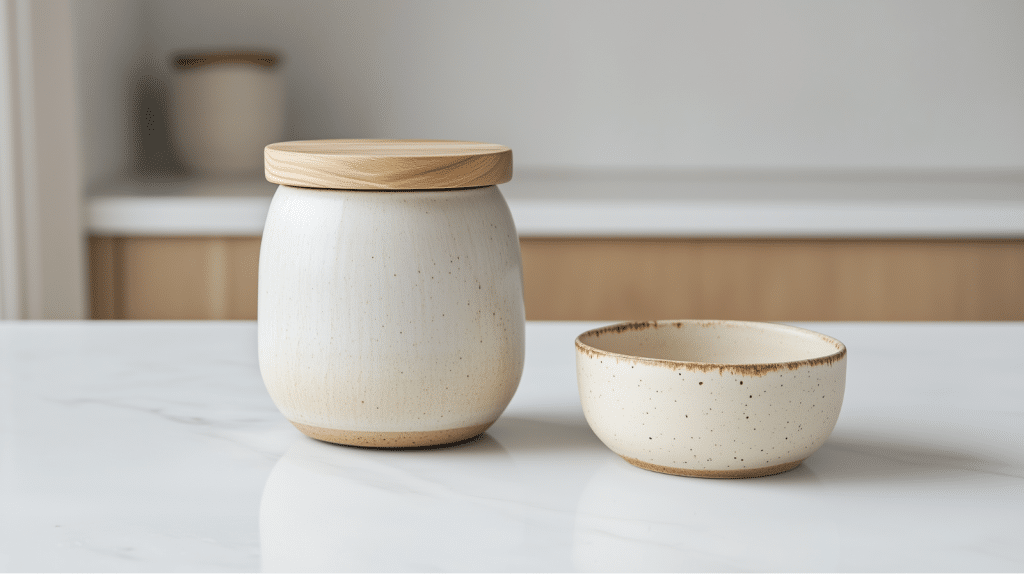
Look for pieces in matte finishes: cream, stone, warm gray, oatmeal, or natural clay. The texture should invite touch. A handmade ceramic canister with an uneven glaze and organic silhouette captures wabi-sabi perfectly, and it actually stores your tea or coffee while doing it.
Choose one or two ceramic pieces for your counter, maximum. A single vessel with presence will always outperform a curated set of three. In Japandi, the lone piece is the statement.
Light Wood Elements
Wood is essential for Japandi warmth, but the type of wood matters enormously. You’re looking at light-toned woods: oak, ash, birch, maple. These bring Scandinavian brightness without feeling cold. Dark walnut or cherry, while beautiful in other styles, feel too heavy for Japandi’s airy serenity.
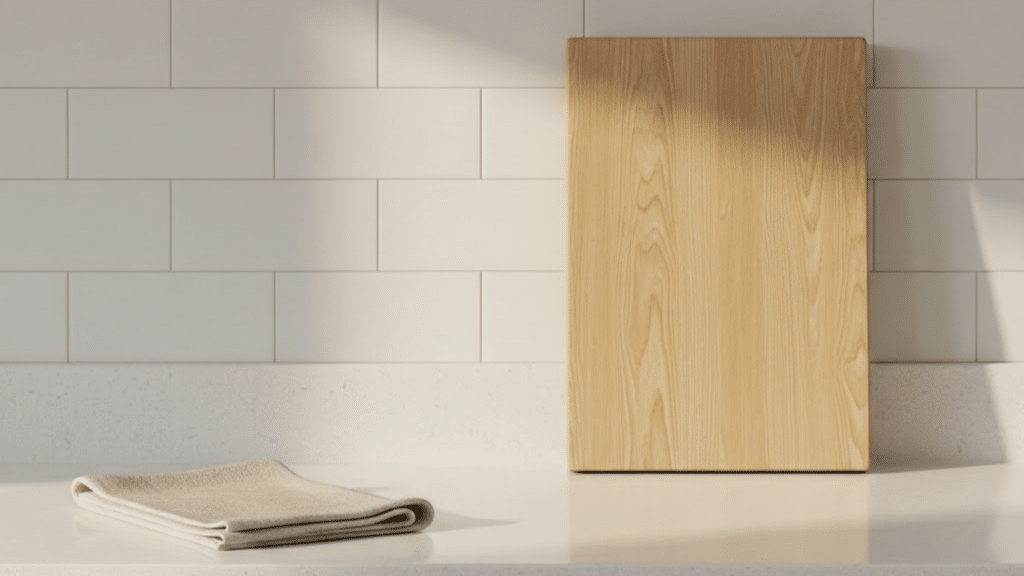
A Japanese Hinoki cutting board with clean edges and visible grain is the perfect Japandi wood piece. It’s functional, adds warmth, and when propped against your backsplash it becomes sculptural. Pair it with a single ceramic piece or nothing at all. The wood should be finished but not heavily lacquered. You want to see and feel the natural grain. Smooth surfaces, clean lines, no decorative carving. Just beautiful wood being quietly beautiful.
Natural Textiles
Linen is the textile of Japandi. A simple linen kitchen towel in natural oatmeal draped beside your cutting board adds softness and texture without introducing visual noise. Choose undyed or naturally dyed textiles in cream, beige, or soft gray.
The textile presence on a Japandi counter is minimal. Maybe one towel, folded simply. Maybe a linen cloth beneath a wooden tray. You’re adding a whisper of softness, not a layer of decoration. If the textile draws attention to itself, it’s doing too much.
Plants: One, Maybe Two, and That’s It
Where modern organic might welcome a couple of well-chosen plants and farmhouse might display an herb garden, Japandi is even more restrained. One plant, deliberately chosen, in a minimal pot. That’s the rule.
The plant should feel architectural rather than lush. A single branch in a simple ceramic vase. A small bonsai-style plant in a matte stoneware pot. One sculptural succulent. You’re bringing in just enough life to keep the space from feeling static, but not so much that greenery becomes a theme.

The pot matters at least as much as the plant. Simple shapes, matte ceramic or concrete, no pattern, no decoration. The vessel should be so quiet that it practically disappears, letting the plant speak for itself.
Hidden Storage
Japandi is philosophically committed to putting things away. If it’s not beautiful and in active daily use, it lives inside a cabinet. A simple ceramic lidded jar for coffee beans. A wooden box with a clean-fitting lid. Items that conceal what’s inside while contributing to the calm of what’s visible.
The difference between Japandi and other minimalist styles is that Japandi doesn’t just remove clutter. It creates beautiful systems for containing what you need. Everything has a deliberately chosen home.
The Right Appliances
Here’s the practical tension of Japandi: you still need a coffee maker and probably a kettle. The Japandi approach is to choose appliances with the cleanest possible design and to limit what stays out to what you use every single day.
A matte white kettle with a simple silhouette works. A minimal pour-over coffee set in ceramic works beautifully and actually looks like it belongs. A stainless steel appliance with ten buttons and a digital display does not. If you can’t find an appliance that complements the aesthetic, store it and bring it out only when you’re using it.
For appliances that must stay out, look for matte finishes in white, cream, or brushed stainless. The simpler the shape, the better. And give it breathing room on the counter so it doesn’t feel crowded.
How to Style Japandi Counters
Understanding the elements is one thing. Knowing how to actually arrange them is where Japandi either succeeds or falls flat. This is the most minimal styling approach in our entire kitchen counter series, and it requires a comfort with emptiness that doesn’t come naturally to most people.
Embrace Ma (Seriously, Leave It Empty)
Start by clearing absolutely everything off your counters. Wipe them down. Stand back and look. That vast expanse of empty surface? In Japandi, that’s not a canvas to fill. That’s the art.
Now add back one item. Just one. A single ceramic vessel, placed off-center with plenty of space around it. Live with that for a day. Notice how the kitchen feels calmer. That feeling is ma, and it’s the entire foundation of Japandi counter styling. You’ll add one or two more items eventually, but starting with one helps you understand that in Japandi, the default is empty and every addition requires justification.
The One-to-Three Item Rule
Where modern organic allows three to five items in a grouping, Japandi caps out at three total on your entire counter. Often it’s closer to one or two. Your entire counter display might be: one handmade ceramic vessel, one light wood cutting board, and one simple plant. That’s a complete Japandi counter. Three items, 85 percent empty space, everything intentional. If someone can’t immediately identify every item on your counter from across the room, you probably have too much.

Imperfect Beauty
This is where wabi-sabi shows up in the styling itself. Your items don’t need to be arranged in a perfect triangle or balanced with mathematical precision. A cutting board can lean at a slight angle. A ceramic vessel can sit slightly off from where you’d expect it. The arrangement should feel natural and unstudied, like the items settled into their places over time.
That said, “unstudied” doesn’t mean random. Each item should feel deliberately placed, even if the deliberation resulted in something asymmetrical. Think of ikebana flower arrangement: it looks simple and natural, but extraordinary thought went into the placement.
Natural Materials Only
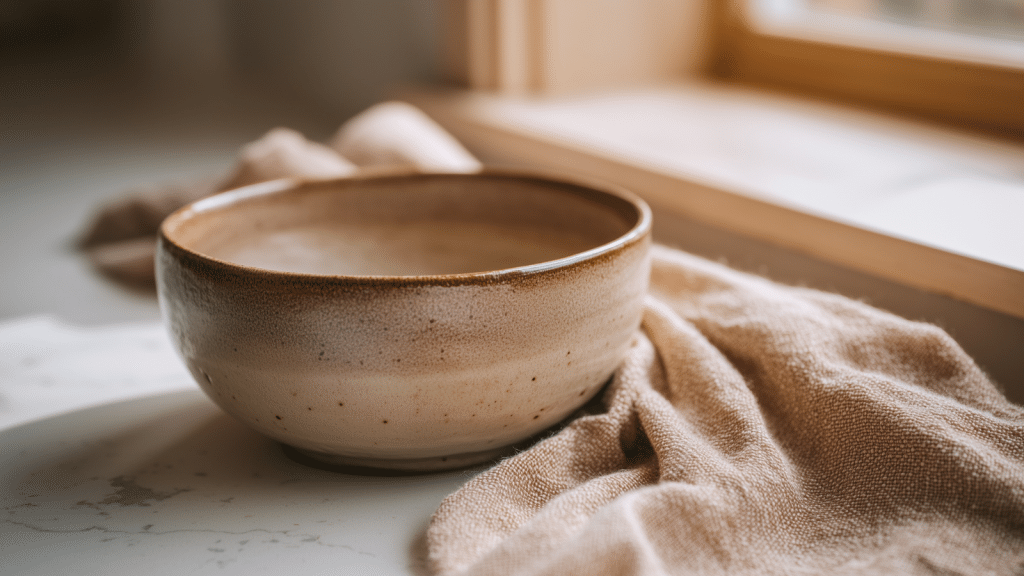
This rule is stricter in Japandi than in any other kitchen style. Plastic has no place here. Silicone trivets, acrylic organizers, neoprene mats – all stored away. Your counter should feature only materials you could find in nature: wood, ceramic, stone, linen, clay, glass in its simplest form.
This extends to less obvious items too. Your soap dispenser should be ceramic or glass, not a plastic pump bottle. If you keep cooking oil on the counter, transfer it to a simple glass or ceramic vessel. Every visible surface and material should feel organic and grounded.
Hidden Storage as Philosophy
In most kitchen styles, “organization” means displaying things attractively. In Japandi, organization means putting things away. Your counters should reveal as little as possible about the full inventory of your kitchen.
This means investing in good cabinet and drawer organization so that everything not currently in use has a proper home. It means breaking the habit of leaving things out “because I’ll use them later.” The few items on your counter are the entire visual story of your kitchen. Make sure that story is worth telling.
Seasonal Japandi Counter Touches
Seasonal changes in a Japandi kitchen are almost imperceptible. Where farmhouse might swap out an entire centerpiece and modern organic might shift its palette, Japandi adjusts by a whisper. The restraint that defines the style year-round applies doubly to seasonal transitions.
Spring
Replace a bare branch with one that’s just starting to bud. Shift your single textile from a deeper tone to natural, undyed linen. Maybe swap a charcoal ceramic for one in soft cream. That’s it. The change is felt more than seen: a slight lightening, a quiet signal that something has shifted.
Summer
Japandi summer is about light and openness. Your counter might actually have fewer items than usual. One ceramic vessel, empty or holding a single stem of greenery. The wood feels lighter. The whole space breathes. If anything, you’re removing an element rather than adding one.
Fall
Bring back a slightly warmer ceramic. A vessel in natural clay or warm stone rather than cool cream. Your branch, if you keep one, might be something dried and sculptural now. The shift is tonal: the same number of items, the same amount of space, but the temperature of the palette warms by a few degrees.
Winter
This is where Japandi feels most itself. Deepen one element: a dark ceramic, a heavier wood piece, a stone. The counter feels grounded and substantial. Winter Japandi isn’t about cozying up with blankets and candles the way hygge might suggest. It’s about hunkering into something solid and elemental. One dark, beautiful object surrounded by quiet empty space.
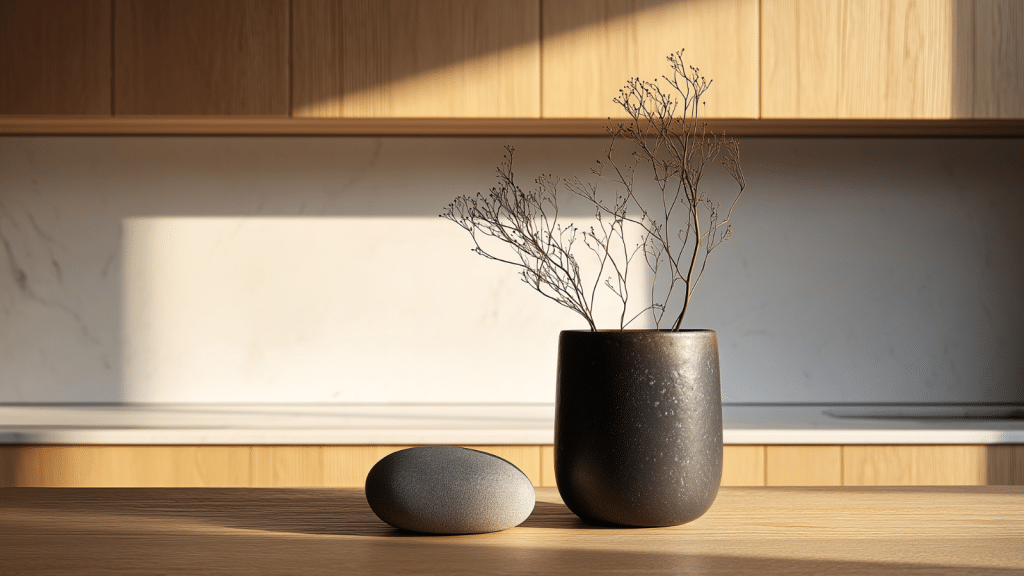
The Japandi seasonal rule: change one item or swap one tone. If someone has to look carefully to notice the difference, you’ve done it right.
If You Love Japandi, You Might Also Like…
Modern Organic
If Japandi appeals to you but feels a little too spare, modern organic keeps the natural materials and intentional styling while allowing more warmth and visual layering. Modern organic typically features three to five items versus Japandi’s one to three. The wood tones can be richer (walnut is welcome), and there’s more room for textural variety.
Both styles value quality over quantity and natural over synthetic, but modern organic gives you more permission to fill the space. If you love Japandi’s philosophy but want just a bit more on your counter, modern organic kitchen countertop decor might be your sweet spot.
Modern
If you’re drawn to Japandi’s clean lines and extreme restraint but less interested in warmth and natural materials, pure modern takes minimalism in a cooler, sleeker direction. Modern counters embrace stainless steel, glass, and high-gloss finishes where Japandi insists on wood, ceramic, and matte textures.
Both share a commitment to negative space and ruthless editing, but the emotional register is different. Japandi feels serene and grounded. Modern feels sophisticated and precise. If you want the discipline without the warmth, explore modern kitchen counter decor.
Farmhouse
This is almost the opposite end of the spectrum, but worth mentioning because some people are drawn to Japandi’s natural materials while actually wanting the warmth and abundance that farmhouse kitchen countertop decor provides. Farmhouse celebrates collection, display, and functional clutter in ways Japandi never would. If Japandi’s restraint feels restrictive rather than peaceful, farmhouse might be where your heart actually lives.
Still Exploring Your Perfect
Kitchen Counter Style?
Take our 2-minute quiz to find out if you’re truly
Farmhouse, Modern, Organic, or Japandi
Plus get personalized product recommendations
Japandi Counter Decor: Frequently Asked Questions
What are the must-have items for Japandi counter decor?
You need remarkably little. One handmade ceramic vessel in a matte neutral finish for storage or display. One light wood element like an oak or ash cutting board. And optionally, one simple plant in a minimal pot. That’s a complete Japandi counter. The point is that each piece is chosen with real intention and given enough space to be appreciated on its own. Quality and meaning over quantity, always.
How is Japandi different from modern organic?
Both styles love natural materials and clean lines, but Japandi takes minimalism further. Modern organic might feature three to five items in a styled grouping; Japandi tops out at one to three on the entire counter. Modern organic allows richer wood tones like walnut; Japandi insists on light woods and extreme simplicity. The biggest philosophical difference is wabi-sabi: Japandi actively celebrates imperfection, while modern organic tends toward smoother, more polished natural finishes.
How is Japandi different from modern or minimalist?
They share a love of negative space and restraint, but the warmth and material palette are completely different. Modern and minimalist styles often feature metals, glass, and high-gloss surfaces. Japandi uses exclusively natural, matte materials like wood, ceramic, stone, and linen. Modern feels cool and precise. Japandi feels warm and serene. And where modern minimalism treats imperfection as a flaw, Japandi’s wabi-sabi philosophy considers it essential.
Can Japandi work in a small kitchen?
Japandi might actually be the best style for a small kitchen. Because it relies on so few items and so much clear counter space, it makes small kitchens feel larger and calmer than they are. The key is to be even more disciplined about what stays out. In a small kitchen, your Japandi counter might feature just one ceramic piece and one wooden element. The simplicity creates a sense of spaciousness that no amount of clever storage hacks can replicate.
Is Japandi too cold or sterile?
This is the most common misconception, and it comes from confusing Japandi with pure minimalism. Japandi should feel warm, not cold. The Scandinavian influence insists on coziness and comfort. If your counter feels sterile, you’re missing the warmth: add a light wood element, choose ceramics with organic shapes and warm-toned glazes, include a soft linen towel. A single handmade ceramic bowl beside a natural linen towel is enough to keep the whole counter from feeling institutional.
How much should I keep on my counters in a Japandi kitchen?
The honest answer: as little as possible. Aim for one to three items total, with 80 to 90 percent of your counter remaining completely clear. Everything that isn’t beautiful and used daily goes inside a cabinet. This sounds extreme, but it’s the foundation of the style. If your counter feels “almost too empty,” you’re probably in exactly the right range.
Less, But Better
Japandi kitchen counter decor isn’t about deprivation. It’s about the discovery that less, when chosen thoughtfully, becomes more. One handmade bowl is more beautiful than five ordinary ones. A single branch in a simple vase says more than a whole bouquet. The empty space between your few chosen pieces is itself a kind of quiet luxury.
The most powerful thing about Japandi is what it gives you back. When you clear your counters of everything that doesn’t truly belong, the kitchen itself emerges. The warmth of the wood. The coolness of the stone. The light through the window that you never noticed because it was landing on a cluttered surface.
Start with one piece. Something handmade, something warm, something that makes you pause when you see it. Put it where it feels right, give it room to breathe, and resist the urge to add anything else for a while. If that one item makes your kitchen feel calmer and more intentional, you’ve already understood Japandi better than any guide could teach you.
Still wondering if Japandi is truly your style? Take our two-minute kitchen counter decor quiz to find out whether you’re Japandi at heart, or if another aesthetic is calling your name.
Your counters are the most visible surface in your kitchen. Let them breathe.


